


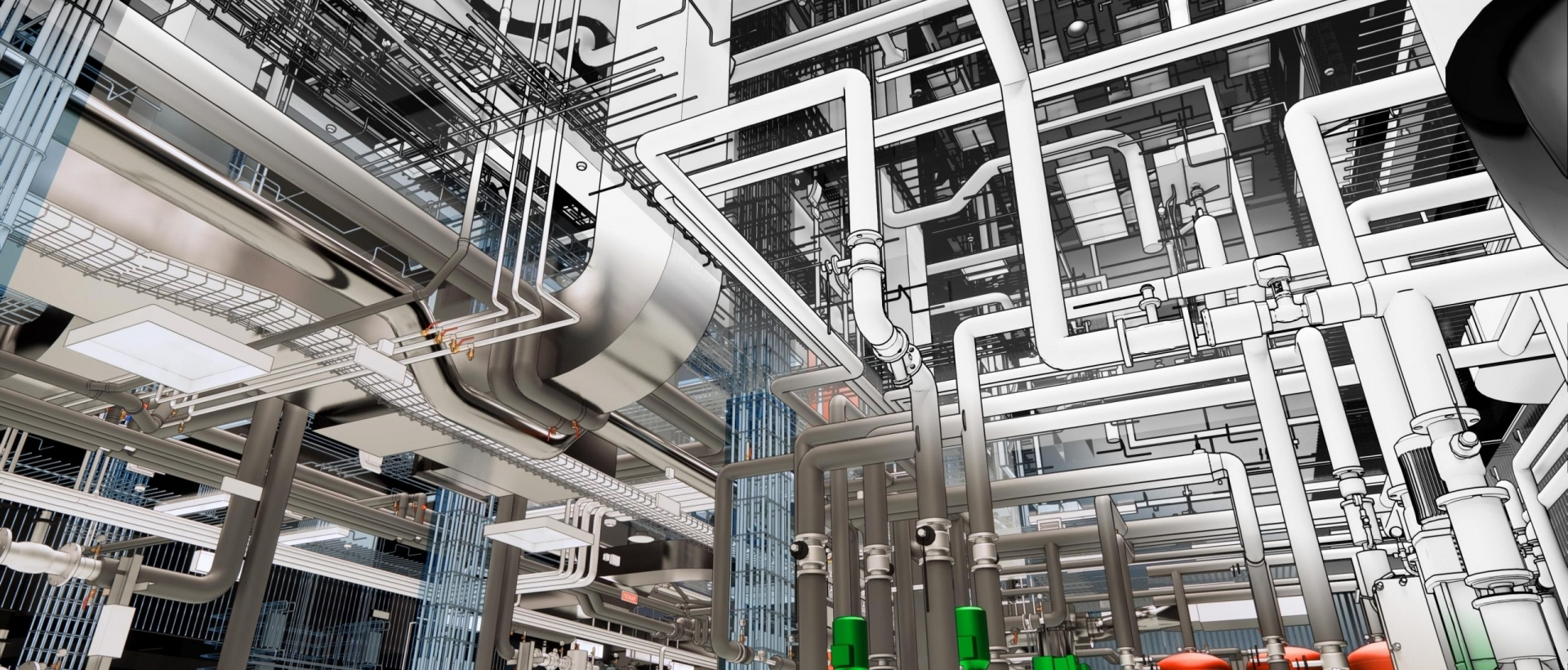
What Are Engineering Systems?
Engineering Systems (ES) are a set of communications, structures, and equipment that are essential for the operation of buildings. Engineering networks provide energy resources, maintain the necessary level of safety and comfort for human life, and in some cases, ES ensures the smooth and accident-free execution of technological processes. When designing and laying all communication systems, it is important to consider many parameters, as each system must fully comply with the approved state standards and regulations, as this directly affects the safety of people. Let’s explore each point in more detail below.
Two Types of Engineering Systems
All communications can be divided into internal and external ES.
External engineering networks are located outside the building and can be connected to an autonomous source or a public network. They are used for supplying electricity, communication, street lighting, water, gas, and other resources to the house.
Internal engineering networks include all communications that are inside the building. These include electrical networks, heating and water supply, internet and telephony, as well as internal drainage and air conditioning. For better understanding, each of the internal networks is described in detail below.
Internal Engineering Systems of Buildings
Heating Supply
Heating in houses and structures is essential for human comfort. This is one of the most important engineering systems in buildings in Russia, as the heating season lasts about six months. There are two heating supply systems – central and local.
Power Supply
The communications include power lines, distribution devices, automation, sockets, and switches. The correct operation of this system is crucial for the safety and fire safety of the building, as nothing should short-circuit or cause a fire. Nowadays, almost all devices operate on electricity.
Water Supply and Sewerage
Water in the right quantity is also a key necessity for comfortable living. This includes drainage collectors, water supply systems, and water intake structures. Water supply can be fire-fighting, industrial, and domestic-drinking.
Ventilation and Air Conditioning
For residential and other facilities, ventilation is considered a mandatory element; without it, their acceptance for operation is not permissible. These ES are necessary for ensuring fresh and clean air in the room, as well as, if necessary, heating, ionization, cooling, or dehumidification. Ventilation exists in any building, even in a cellar, to prevent moisture.
Gas Supply
Gas supply is present in many facilities, as it is a fairly common and one of the cheapest types of fuel for heating, organizing autonomous heating, and cooking food. Gas supply is considered a sought-after source for heating residential spaces because gas prices are low and there is no comparable alternative.
Modern Engineering Systems
The world and people are evolving, and ES are also expanding both qualitatively and quantitatively. About 20 years ago, high-speed internet access was something fantastic, but now it is one of the mandatory requirements for all comfort-class residential buildings and above.
Without heating, water, and other vital life systems, it is impossible to live fully, but in addition, low-voltage networks are now being laid in every apartment and production facility. Low-voltage networks are technical solutions that operate using electric currents with low voltage (up to 24V). Therefore, they do not pose a threat to life and do not cause harm.
Types of Low-Voltage Systems
All these communications are divided into two types. They may vary, but their main difference is size.
Household Networks
As the name suggests, these are used in residential buildings and apartments. They include:
-
- “Smart Home.” This is a modern system that integrates all communications into one and can be managed by artificial intelligence. Clients can program and customize it according to their preferences.
-
- Telephony. The telephone line, before the advent of mobile communication, was the most popular way to communicate over distances. However, even now, in many regions, especially in small towns and rural areas, this line is connected, and a multi-channel communication system is increasingly used to ensure quick contact with a specific subscriber.
-
- Television. For most, antennas and analog channels are no longer relevant, replaced by satellite TV. However, the “dish” still needs to be connected to a device. Nowadays, many apartments have several televisions that connect with each other via low-voltage networks.
-
- Internet. This line can be wired or wireless, but a wired connection is safer and more reliable. It ensures uninterrupted communication and good data transfer rates. Cables and routers transmit signals from the internet provider to the consumer. This type of low-voltage network is used in both residential and commercial spaces.
-
- Intercom. These networks are particularly popular in high-rise buildings. The desire to protect one’s life from outsiders is natural. An intercom allows you to see who has come and to open the door.
-
- Radio Broadcasting. This type of communication is hardly used anymore, but radio points can still be found
-
- Alarm Systems. Residents who are concerned about the safety of their property often install a complete set of equipment in their apartment or house: surveillance and alert sensors, video cameras. This is a complex low-voltage system. Sometimes such devices immediately notify law enforcement or security organizations so that measures can be taken quickly.
Commercial Networks
These include the same communications as household systems, but on a different scale. For example, along with external telephony, internal communication between company departments is established. The following low-voltage systems are included in commercial networks:
Fire Safety
This is one of the most important systems in a building; its presence is checked by regulatory bodies. Without it, the property cannot be put into operation.
Local Area Network (LAN)
Depending on the location of the premises and other factors, LANs can be implemented in various ways, but the most popular configurations are ring or star topologies.
Alert Systems
These are used within the production facilities. They are public address systems that broadcast information to employees.
Principles of Working with Engineering Networks
Design
When designing internal and external ES, all factors must be considered. Experienced designers know how to combine regulations and technical requirements with client preferences. The main regulations that the project documentation must comply with are primarily the Urban Planning Code of Russia, GOST (State Standards), SP (Construction Rules), and Government Resolution No. 87. In addition, there are specific acts for each type of internal and external communications.
ES is always individual; hence, it is not possible to create them exactly as shown in pictures from the internet or videos on YouTube.
The design process can be divided into the following stages:
-
- Data Collection: Specialists familiarize themselves with the territory, calculate possible nuances, and develop options.
-
- Sketch Development: This includes the drafting and visual presentation of ideas and preferences of the client. A schematic is necessary to accurately know the future location of all devices. This stage is fundamental for further actions.
-
- Creating Technical Specifications: This document describes all the requirements, conditions, goals, and tasks to be realized in the project documentation, set by the client and formally documented.
-
- Development of Project Documentation: This document outlines all the solutions for the installation work. This allows for the precise determination of the budget for the equipment.
Installation
Proper installation of engineering networks is the key to the longevity and safety of buildings. The installation of engineering equipment in buildings is referred to as “sanitary and technical work.” It includes heating, ventilation, gas supply, water supply, and sewage systems. As noted before, there are external and internal networks, and the installation work is also divided into these two stages.
External communications are laid using machinery, while internal ones require attention and careful calculations by engineers due to their complex structure. There is a significant difference between the installation of residential and industrial objects. There are strict controls on parameters, regulations, and mandatory requirements for the operation of a facility in the case of an industrial building. Installation also includes commissioning and acceptance for operation.
Commissioning
This is an examination needed during the preparation of all lines prior to the operation of engineering systems. It is considered the final stage of installation. Commissioning helps to determine whether all equipment is functioning correctly and whether there are any failures.
After the installation work is completed, the following steps must be taken:
-
- Test the heating, heat supply, water, and sewage systems using hydrostatic or manometric methods.
-
- Test the internal sewage and drainage systems.
-
- Individually test the installed equipment.
-
- Check the heating for uniform heating of heating devices.
Commissioning is always individualized. Depending on the equipment, testing may last up to three days.
Service Maintenance and Repair
Power Supply Repair
Service maintenance is often referred to as planned preventive maintenance, as it is carried out in scheduled intervals regardless of the condition. This ensures maximum economic efficiency and prevents emergency situations.
With each passing year, quality criteria change as technologies become more advanced. Therefore, old components are replaced to optimize costs. It is important to know that each engineering communication has a wear period, but there are situations where it must be replaced earlier. Repairs are planned considering existing malfunctions. In emergency situations, repairs are carried out urgently if necessary for the full functioning of the facility.
Each structure always differs from another, so a different approach is taken to objects, considering the desires of the client and state requirements.
Maintenance of Engineering Systems
Conclusions
The establishment of internal and external ES is a necessary and critical stage in the construction of any facility. The proper installation and functioning of communications directly affect the comfort of life or work for people. Therefore, we at “VI Prpject” specialize in the design, installation, and maintenance of engineering systems in Moscow and the Moscow Region. We have assembled a qualified team of engineers with at least 5 years of experience.
The company’s employees will prepare the technical specifications, develop the project, coordinate all details with regulatory authorities, and also perform the installation at the facility. We operate in the following areas:
-
- Ventilation
-
- Water Supply
-
- Heating
-
- Air Conditioning
-
- Sewerage
Our comprehensive approach allows us to offer more advantageous pricing proposals for our clients. Additionally, we utilize CAD software and have our own production and storage facilities for manufacturing ducting and other equipment for ventilation systems.